
Excerpt: Jonathan, Reflecting on His Friendship with David
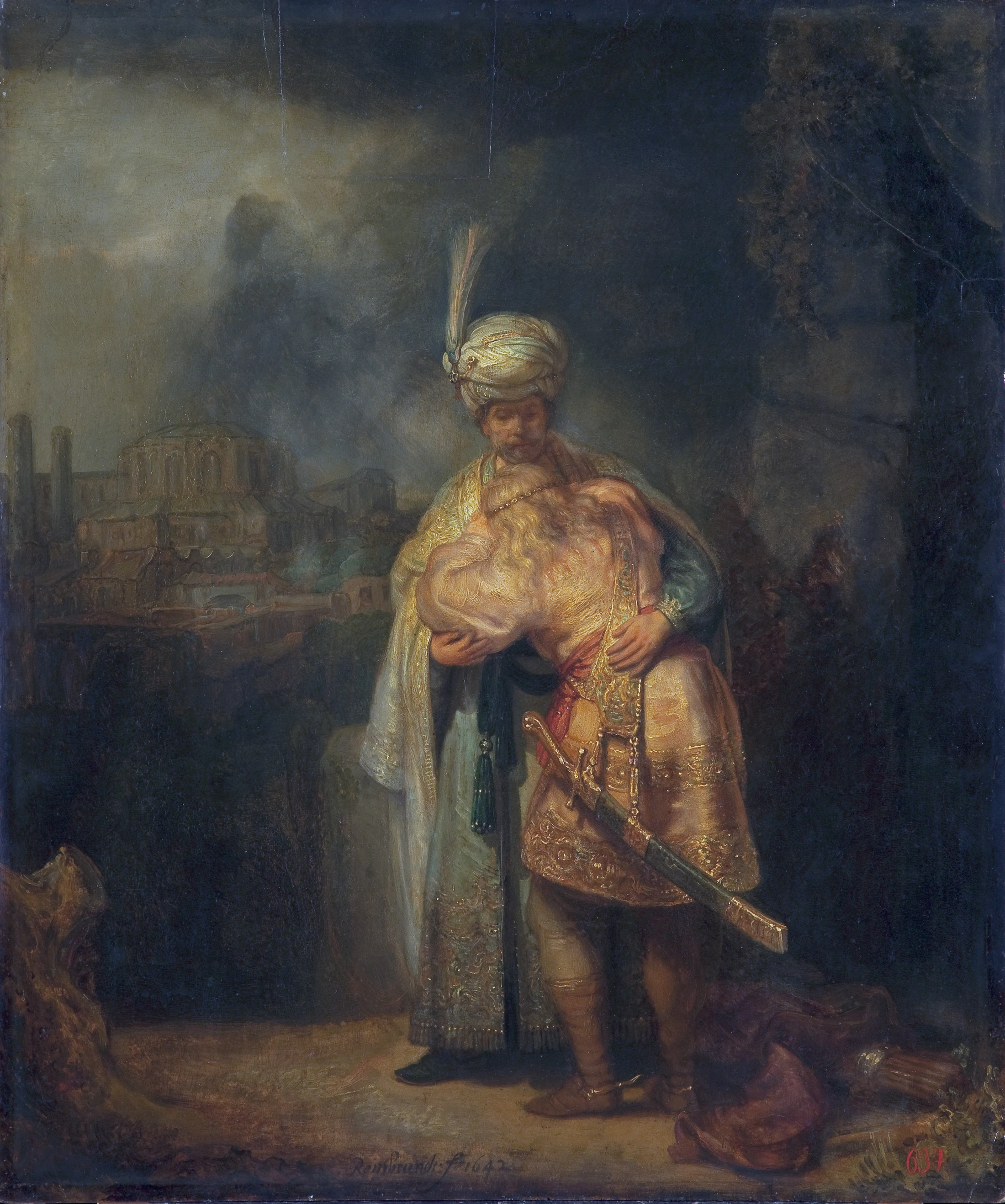
Once again, I have an excerpt from a writing project I did a few years ago. It was a series of short vignettes in which I imagined the thoughts of certain Old Testament Biblical characters as they went through significant moments in their lives. Here is what I imagined Jonathan would think when he reflects on his friendship with David.
I Samuel 18:1
After David had finished talking with Saul, Jonathan became one in spirit with David, and he loved him as himself.
O Lord, thank you for David, my friend who I love.
David by all rational considerations should be my enemy, and so it is whispered throughout the household of my father that we play each other false, that the professed and much remarked upon love we share is no more than a carefully managed front designed to confuse each other while in competition we make our alliances, each pursuing for his own ends the throne that has been promised to David when my father dies. In this view, our friendship is a veneer upon ambitious hearts, perhaps on some level sincere, but at the bottom a temporary convenience, a scattering of dust in my opponent’s eye. The root of our supposed rivalry is clear enough, since the scepter will pass from its rightful (in the eyes of the world, no more!) inheritor to a shepherd (people often forget my own father was a donkey wrangler) from a different clan, and him the youngest of eight sons! He is an upstart driven to prominence by his heroic exploits against the Philistines, and I, though heroic enough in my own right, am the unacclaimed royal son. I know the gossips wonder about our approaching enmity, the day when Saul dies and the two rivals grasp for the throne, like men of the world, as if this were any other kingdom, and the throne any other throne!
No, this is foolishness, spoken only by foolish men, those who cannot penetrate and know the power of God. He, after all, chose David, even as he did my father, sending the holy man Samuel to anoint his head and proclaim him king. This is the decree of God, spoken through his prophet, as he decrees all things. A word, a spoken word by God himself, declaring and decreeing: “This man will be king,” the oil poured on his head symbolizing the glorious presence of the Spirit in him, the Spirit of God which enables men to rule. This is the pattern, once done for my father, though the Spirit has long abandoned him, never dwelling with him. Even in his past it came upon for only a few moments at a time, his brief days of glory when he prophesied and by God’s power struck down our enemies. Those days are over, my father’s power gone, and now he coasts on the memories in his own mind and in the people’s. He cowers and blusters alternately, according to his perception of his power, hiding when weak and strutting when strong. It is pathetic to watch.
I love my father. I cannot but love him. But this love makes no unreasonable claim on me. I will obey him as king, as father, as the created order demands that I do. But if he sets himself up against the God of heaven, he will not find me at his side, for no man can oppose God and live.
I must submit my heart to God, and where my heart goes, so goes my conversation. Were David the most odious man in Israel, he and I opposed in our spirits from natural differences, were he hated by me in bitterness, yet even then I must submit my heart to what God has done, for God has done it. Need there by any other reason but that God has done it? This is easy at times and hard at others, but it is as it is. Let God’s word stand, and you may stand with it.
Remember, heart, remember when you ventured on God that day when my father hid! O heart, thrill to it, the memory of fighting in his power! O to live through and for him is a great gift, and in his power I am as I should be. This will ever be my glory, charging that hill with my shield-bearer, carried up by the Spirit-given confidence in God’s power, the sudden realization that God could save be whether by many or by few. My heart owns that day, that moment, and it cannot be taken from me.
This memory, in its positive manifestation, fuels my consideration of God in his negative manifestation. Alike but opposite, for the God who struck down the Philistines with my sword can also strike me down by David’s sword. This is fear, a lower emotion, a motivation that is neutral with regard to David himself, considering as it does only God, not the one God defends. Thus it is also joy that the one God defends is also the one my heart springs up to defend, the one for whom my sword will ever move, the one to whom my whole self submits, for though I would submit to him as an ordered act (meaning, that in my submission to God himself I also submit to the one his hand places over me), God has given grace, a surpassing grace, to unite also my heart to the one to whom I submit, making it a joy.
David is my friend.
Friendship, that unique gift, that beautiful thing, reveals to us that God is a God of comfort, that God is a God of good pleasure and happiness. For what is more pleasing than a friend? Men can interact with each other as they choose, in kindness, patience, cheerfulness, but upon two hearts comes suddenly a mysterious surpassing, a whole emerging from this mass of connections that is greater than its parts, a joy that exceeds what the rational mind would expect, both a joy and an enjoyment. Friendship delights not only in the object but in the delight itself, celebrating itself even as it celebrates each party. For I love David, but I also love our love.
David is my friend. We enjoy one another’s company. When I am with him, I feel safety and joy, that I can share all with him without fear of reprisal, without fear of it being leveraged against me (so opposite from what the slanders make of us!). I return this also to him, hearing of his secret sins and fears, the distresses of his awkward position. Because I have surrendered my heart to his kingship, serving him indeed as king now, for he is king before the Lord and I also stand before the Lord, because of this yielding we have peace and trust, a trust that moves beyond our situation, transcending it for it gives us a glimpse of each other’s hearts. What God gives, he gives, and we possess his gift, this friendship, unexplainable.
See its parts and examine it. First, there is a mutual direction, a shared goal. Some friendships are summed up by this, though such friendships do not deserve the name. Second, there is an investment of time in which the two parties are focused on one another. Friendship is wasteful. Third, hilarity and laughter, that marking of all friendships, the causing of joy in one another. Friends give life a savor. Fourth, a persistence, a moving through, a determination towards a person. No friendship is properly known until it has been tried, until something has examined it. Fifth, something.
Yes, an ineffable something, for we all recognize it though we have no power to reproduce it. I will define it, though in its definition it will perhaps grow more mysterious. It is a motion of God’s Spirit that makes our spirits one. This is friendship, a oneness that rests in the spirits of each man but is nurtured by their actions, their choices. Why does God cause this in us? There is no necessity to it, no requirement. Yes, we live in community, banding together for mutual protection, the providing of strength where others are weak in an exchange that makes the whole people stronger. But friendship goes quite beyond this to endue such strengthenings with an unexplainable joy, to give us these heart connections that exalt and magnify our shared paths. For in friendship we walk together, a necessary action, but it is unnecessary that the walking should also be a joy. What grace is displayed here! What surpassing compassion! God reveals himself to us in our friendships as a God of sweetness, even as he revealed himself to Moses and to our beloved ancestors!
But we are men yet. Friendship, even at its most profound, can be broken, destroyed, the gift of God swept away. Friendship can grow cold, distant, a joy lost, a pleasure forsaken when in the midst of friendship’s self-forgetting joys we are ambushed by a sudden sense of ourselves, a sudden reminder that this is two in one, and that in each moment to be one requires a forsaking of something.
This is how it is in this poor world, in all things. To gain greater joys we must forsake the lesser, and friendship is no different. O to be king! I won’t deny that my heart desires it. Nor that as David reveals himself to me, the thought comes unbidden that I deserve it. Then also, to see him the fullness of his adulation, when the crowds acclaimed him as greater than Saul, in those moments my heart betrayed me in the pettiness of jealousy, for all men desire the praise of the people, and I am a man after all! No perfection, no flawless selflessness yet in this poor flesh. I see and desire, the longings of my undisciplined heart occasionally breaking forth into unlawful emotions, and hatred lurks beneath my love, always.
Therefore, I will walk in the chosen actions of love, the deliberate choices of self-giving, the discipline of it like a fasting, even as I nurture our friendship and fan the flames of my love for him. He is my friend, one for whom I will give up all, to whom I have already given all. He will be king and I will pass into obscurity, serving him according to all his needs, making him greater and myself less, and in this submitting to the created purposes of God. That in this there is the joy of our unified spirits is only the abundance of God’s grace, a sign that there is joy in him to overflow into all things, and that somewhere in the mysteries of these things he communicates himself to us. If this pleasure is mine, what will we possess in the future, when all the lowness of our natures is burnt away, when the oneness of the whole people will be seen and understood, when we will all stand in our future redemption as one, in the pattern of my submission to David? Friendship reveals God, as all his works do, showing to us his love, that in unity there is a joy that surpasses what can be attained alone, that in knowing a person we must first make ourselves known, and that God has prepared a deeper unity that our friendships here can only shadow, can only hint at. Unity, then, is our great desire, our great joy, our great pleasure, our great hope, and in the knitting, the abundance of his love is seen.