
Is the Story of the Woman Caught in Adultery Trustworthy?
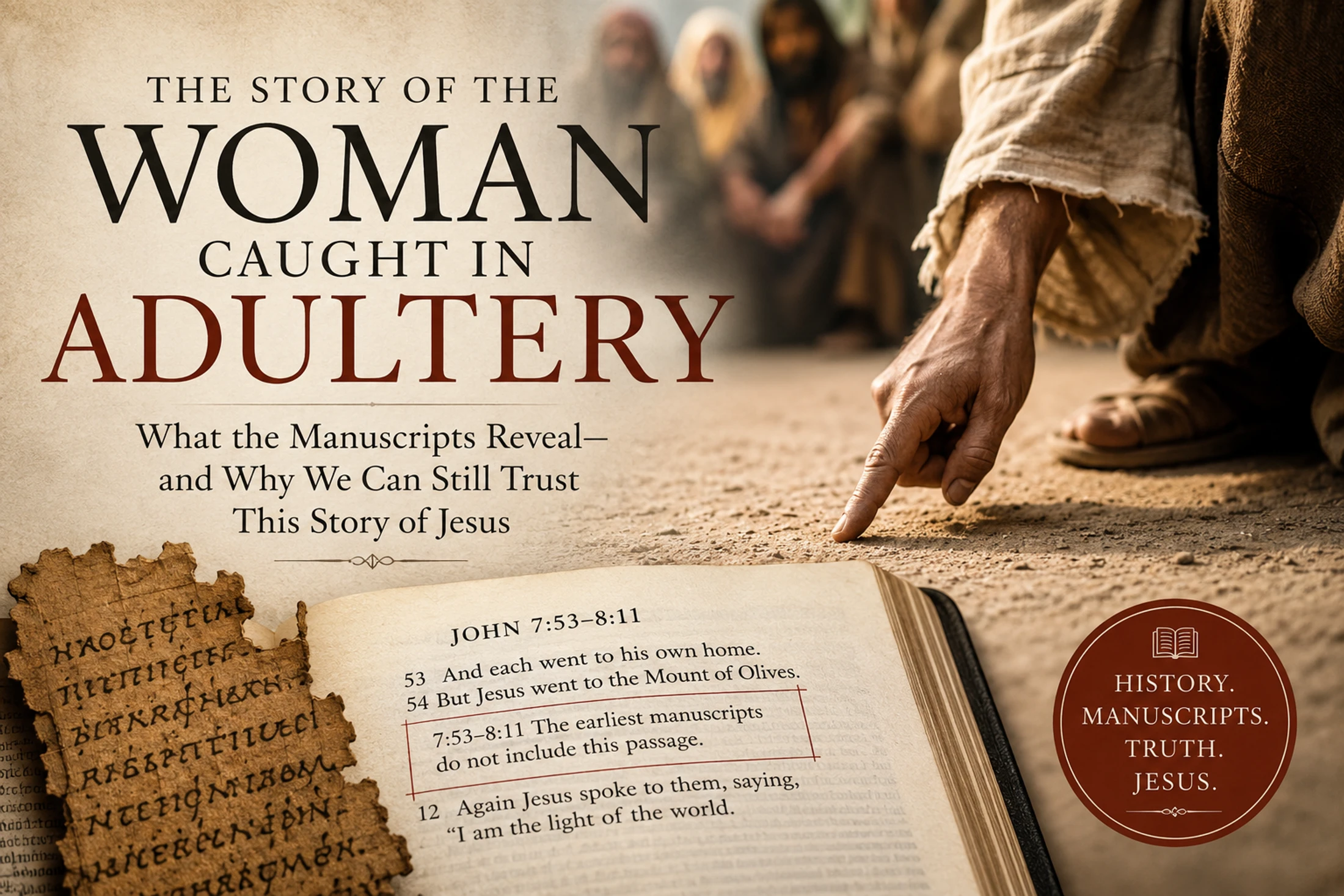
This past Sunday, Pastor Dave preached on what scholars call the Pericope Adulterae, or the story of the woman caught in adultery. Found at the end of John 7 and the beginning of John 8, it is one of the most famous episodes from the life of Jesus. One of his most well-known statements occurs here, when he tells the crowd gathered around the woman, “Let him who is without sin cast the first stone.”
If you looked carefully at your Bible while we were reading, however, you might have noticed something interesting. In most modern translations, the story is enclosed in double brackets or set off with a footnote that reads something like, “The earliest manuscripts do not include John 7:53–8:11.” Wait a second! What does that mean? Should we even be reading this passage?
There isn't a simple answer to that question. Since Pastor Dave preached on this passage last Sunday, we should begin by saying that we believe it is a trustworthy and authentic story from the life of Jesus. It contains no teaching that is out of step with the rest of Scripture, and the portrait it gives us of Jesus is entirely consistent with what we find elsewhere in the Gospels. But why isn't it found in the earliest manuscripts, and what should we make of that?
For centuries, the primary Bible used throughout the English-speaking world was what was sometimes called the "Authorized Version," more commonly known as the King James Version. Before the Reformation, the standard Bible of the Western Church was the Latin Vulgate, a translation produced in the fourth century by the scholar Jerome. During the Renaissance, a renewed interest in returning to the original languages of Scripture led scholars to study Greek and Hebrew once again. One of these scholars was Erasmus, a contemporary of Martin Luther, who published a printed edition of the Greek New Testament using the Byzantine Greek manuscripts available to him. His edition eventually became known as the Textus Receptus ("the Received Text").
During and after the Reformation, translators used the Textus Receptus as the basis for many new vernacular Bibles, including the King James Version.
The Textus Receptus is generally a reliable Greek text, but it was not perfect. Erasmus had access to only a small number of Greek manuscripts, most of them dating to the medieval period. Relevant to our discussion, all of those manuscripts included the story of the woman caught in adultery.
Today, however, we possess a far greater number and variety of Greek manuscripts, including some that date to the second and third centuries. None of our earliest manuscripts of John's Gospel contain this story. The earliest surviving Greek manuscript that does include it is the fifth-century Codex Bezae. Likewise, the earliest Christian commentators on John's Gospel move directly from John 7:52 to 8:12 without mentioning the passage. Clear references to the story do not begin to appear until around the fourth century. Another significant detail is that the manuscripts which do include the story do not all place it in the same location. Some place it where it appears today, while others insert it elsewhere in John or even in Luke's Gospel.
So what probably happened?
The most likely explanation is that John's Gospel originally circulated without this story. At some point, an authentic account from the life of Jesus began circulating alongside the Gospels and was eventually copied into John's Gospel by scribes who believed it belonged with the biblical text. We cannot know exactly how this happened. Perhaps the story came from another writing by John, or from his preaching, or from another early eyewitness tradition that the church carefully preserved. Since only a tiny fraction of first-century Christian manuscripts have survived, it is also possible that some very early copies of John included the story while others did not.
Whatever its precise history, by the fifth century the church had largely come to recognize the passage as a faithful and trustworthy account of Jesus' ministry, and it became firmly established in the manuscript tradition used throughout the medieval church.
I think that remains the best way to understand it today. Although the story was probably not part of John's original Gospel, it bears all the marks of authenticity. Jesus' actions, his compassion, his wisdom, and his refusal to compromise either justice or mercy are entirely consistent with everything else we know about him from Scripture. For that reason, while modern Bibles rightly note its unusual textual history, Christians can still read this passage with confidence as a trustworthy witness to the character and ministry of our Lord.